National SecurityConstitutional LawGovernmentMedia Literacy
March 10, 2026Hegseth tells 60 Minutes public won't be told if troops enter Iran
Seventh U.S. soldier died the day Hegseth said Iran was "toast"

Photo: CBS News
Defense Secretary Pete Hegseth sat for an interview with CBS News correspondent Major Garrett on 60 Minutes that aired on Sunday, March 8, 2026, ten days into Operation Epic Fury. Garrett asked whether U.S. forces were on the ground in Iran. Hegseth confirmed they were not, then added with a smirk: "But we reserve the right. We would be completely unwise if we did not reserve the right to take any particular option, whether it included boots on the ground or no boots on the ground."
He was then asked directly whether he would tell the public if ground troops were deployed. "Uh, I wouldn't tell you that if we did," he said. He elaborated: "President Trump knows — I know — you don't tell the enemy, you don't tell the press, you don't tell anybody what your limits would be on an operation. We're willing to go as far as we need to in order to be successful." CBS News PBS NewsHour
The exchange captured a stated policy of deliberate opacity about the war's scope and endpoint. Hegseth said it would be foolish for the administration to publicly declare what it would or would not do, how long the operation would last, or what military options were reserved. "People ask, 'Boots on the ground, no boots on the ground? Four weeks, two weeks, six weeks? Go in, go in,'" he said, dismissing the questions as the wrong framework.
That position directly contradicts the requirement in the of 1973 that a president consult Congress before introducing forces into hostilities and provide regular reports on the scope of military operations. The resolution does not require the president to publicly announce troop movements in real time, but it does require the executive branch to keep Congress informed, not just the public. Several senators said after classified briefings that they had not received answers to the same questions Hegseth deflected on 60 Minutes. The Hill War Powers Resolution
Hegseth also told 60 Minutes the war was "very much on track, on plan," and dismissed Russia's covert provision of targeting intelligence to Iran as irrelevant to the safety of U.S. troops. "No one is putting us in danger," he said. "We're putting their guys in danger. We're tracking everything. Our commanders are aware of everything. The only ones that need to be worried right now are Iranians who think they are going to live."
He acknowledged casualties directly, saying: "Things like this don't happen without casualties. There will be more casualties. Especially our generation knows what it's like to see Americans come home in caskets. But that doesn't weaken us one bit. It stiffens our spine and our resolve to say this is a fight we will finish." Seven U.S. service members had been killed by the time the interview aired. CBS News RFERL
The 60 Minutes appearance came alongside a broader pattern of public statements that drew scrutiny as departures from how U.S. defense secretaries have historically communicated during wartime. The Christian Science Monitor reported on March 11 that Hegseth had decried "stupid rules of engagement," rejected "politically correct wars," and told U.S. troops to be "focused, disciplined, lethal, and unbreakable." He criticized European allies for what he called clutching their pearls in the face of American action.
Retired Brigadier General Steven Anderson, who served during the Iraq War, told the Monitor: "He's all about the macho, bro culture. All of this tough-guy nonsense — all this talk about killing — appeals, no doubt, to some elements of the military." But not to most senior officers, Anderson said, who are more accustomed to a walk-softly-and-carry-a-big-stick approach. Gen. Dan Caine, the Chairman of the Joint Chiefs of Staff, took a markedly different tone at a March 4 Pentagon briefing, opening with condolences for the fallen and expressions of gratitude for the troops before discussing operations. CBS News RealClearPolitics
The question of whether the public will be told when ground troops enter a conflict has a specific legal and political history in American war-making. After the 2002 Authorization for Use of Military Force in Iraq, the Bush administration used broad interpretations of that authorization to conduct operations in countries not specifically named in the original vote. After 2001, the Obama administration used drone strikes in Yemen, Somalia, and Pakistan — operations largely not disclosed to the public until years later.
No congressional authorization exists for Operation Epic Fury. The administration is relying on Article II of the U.S. Constitution, the president's commander-in-chief power, and a disputed reading of the War Powers Resolution that treats Iranian behavior as constituting an imminent threat exempting the president from the consultation requirement. If ground troops were deployed without disclosure and without a new authorization, it would represent a further expansion of executive war-making authority with no congressional check applied at the moment of escalation. War Powers Resolution RFERL
Hegseth's role in managing public information about the war extended beyond the 60 Minutes interview. In earlier Pentagon briefings, he declined to define the war's success criteria, declined to state an exit strategy, and declined to put a timeline on the operation's completion. Press Secretary Karoline Leavitt separately told reporters the administration had no timeline for reopening the Strait of Hormuz to commercial traffic.
The pattern of strategic ambiguity was argued internally as a military advantage: not telegraphing moves to the enemy. Critics, including senators from both parties who walked out of classified briefings, argued it also meant the administration had not resolved those questions internally and was using opacity as a substitute for a coherent plan. The Hill CBS News
Related Topics
6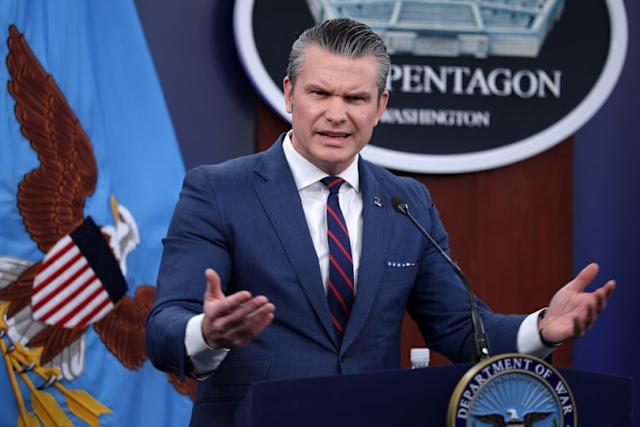
Hegseth says press covers troop deaths to hurt Trump
Six soldiers from Des Moines killed the same day Hegseth blamed press for reporting it

Pentagon told Congress Iran attack was not imminent as Trump claimed threat
Trump said "imminent threat." His own intelligence said 2035, at the earliest

They all promised no regime change in Iran. The record says otherwise
Trump, Vance, Hegseth, Rubio said it. Greene and Carlson documented the betrayal

US and Iran resume nuclear talks as two carrier strike groups mass in Persian Gulf
US deploys F-22s to Israel for first time, two carrier groups now in region
Trump starts Iran war without Congress triggering constitutional crisis
No vote, no declaration — Trump says American heroes may die in this war
Defense Secretary Pete Hegseth says forces will show no quarter in Iran
Pentagon's own Law of War Manual calls such orders a war crime
26 questions
Start the review