Immigration · Judicial Review · Constitutional Law · Justice·March 23, 2026
Judge blocks DHS from detaining refugees who lack green cards
Federal judge blocks DHS arrest of legally admitted refugees in Boston

Photo: Raquel Natalicchio / Houston Chronicle/Staff photographer
A DHS enforcement program called "Operation PARRIS" (Post-Admission Refugee Reinvestigation and Integrity Strengthening) directed the warrantless arrest and mandatory detention of legally admitted refugees who had lived in the United States for at least one year without obtaining a green card. Six refugees and two Massachusetts resettlement agencies sued in federal court, arguing the policy reinterpreted immigration law in a way that contradicted decades of established practice. U.S. District Judge Richard Stearns in Boston blocked enforcement on March 23, 2026, ruling it was an unlawful departure from how immigration authorities have operated since the Refugee Act of 1980. The plaintiffs are represented by Democracy Forward and the International Refugee Assistance Project. Under current USCIS backlogs, the average wait for a refugee green card interview reaches 26 months, meaning tens of thousands of legally admitted refugees could have faced arrest under the policy even with pending applications filed. The ruling is a 📖preliminary injunction; the administration is expected to appeal.
Key facts
"Refugees admitted to the United States go through a separate legal process from 📖asylum seekers or undocumented immigrants. They are screened and vetted overseas by the United Nations High Commissioner for Refugees and multiple U.S. agencies before arriving, then formally admitted under the Refugee Act of 1980. That law grants them protected legal status and requires them to apply for lawful permanent resident status, a green card, after one year in the country. Immigration authorities have historically recognized that USCIS processing backlogs mean many refugees have pending applications but haven't yet received a final decision or even an interview date.\n\nOperation PARRIS reinterpreted that one-year application requirement as a mandatory trigger for arrest and detention. Under the DHS policy, any refugee who had been in the United States for more than 12 months without an approved green card was subject to warrantless arrest and indefinite detention, regardless of whether they had a pending application or were waiting for a USCIS interview."
"DHS named the program Operation PARRIS, which stands for Post-Admission Refugee Reinvestigation and Integrity Strengthening. It directed immigration officers to identify and detain refugees who had not yet adjusted their status, treating pending or unsubmitted green card applications as grounds for mandatory custody. The policy targeted refugees who had entered legally, cleared background checks, and had no criminal record.\n\nThe International Refugee Assistance Project described the policy as unprecedented in the history of U.S. refugee resettlement. No prior administration had used the one-year adjustment requirement as a basis for mandatory detention. Legal scholars said the policy confused the administrative obligation to apply for a green card with refugee legal status itself, which doesn't expire because a green card application is delayed."
"USCIS processing backlogs have left hundreds of thousands of refugees waiting for green card interviews. The average wait time for a refugee adjustment of status interview reached 26 months in fiscal year 2025, up from 14 months in 2022. Many refugees who have been in the United States for more than a year have already submitted their applications but have not received an interview date or a final decision.\n\nUnder Operation PARRIS as written, a refugee with a pending application who had not yet received an interview date would still have been subject to arrest. Advocates called this a deliberate use of an agency-created backlog as a legal trap against people who had followed the law exactly as required."
"Six refugees living in Massachusetts, along with Jewish Family Service of Western Massachusetts and the International Institute of New England, filed a federal lawsuit in the U.S. District Court for the District of Massachusetts in early March 2026. Democracy Forward and the International Refugee Assistance Project represented the plaintiffs. The lawsuit argued the DHS policy was an unlawful reinterpretation of the Immigration and Nationality Act, violated due process, and was arbitrary and capricious under the Administrative Procedure Act.\n\nThe plaintiff refugees originally came from countries including Afghanistan, Ethiopia, and the Democratic Republic of Congo. Several had been in the United States for 12 to 24 months and had pending green card applications in active USCIS processing when DHS announced Operation PARRIS."
"U.S. District Judge Richard Stearns, a Clinton appointee in Boston, blocked enforcement of the policy on March 23, 2026. He ruled the DHS policy was an unlawful departure from decades of practice and that the plaintiffs were likely to succeed on the merits of their legal challenge. The 📖preliminary injunction prevents DHS from arresting or detaining refugees under Operation PARRIS while the case proceeds on the merits.\n\nJudge Stearns found that DHS had provided no legal authority supporting its novel interpretation that refugees who haven't completed the green card process are subject to mandatory detention. The injunction applies to the six named plaintiffs and to a broader class of similarly situated refugees. The administration is expected to appeal to the First Circuit."
"The ruling adds to a growing body of federal court decisions blocking 📖immigration enforcement actions that target legally admitted or protected individuals. Courts have issued injunctions against DHS policies targeting visa holders, Temporary Protected Status recipients, 📖asylum seekers, and immigrants with pending humanitarian applications in recent months. The administration has appealed many of those rulings, creating a stack of immigration cases working through the circuit courts toward the Supreme Court.\n\nThe refugee detention case is distinct because it targets individuals with the most thorough pre-admission screening of any immigration category, making it harder for the government to argue an unvetted risk justifies mandatory detention."
"The principle of non-refoulement, embedded in the 1951 Refugee Convention and U.S. law, prohibits returning people to countries where they face persecution. Mandatory detention of refugees without criminal grounds implicates that principle if it leads to de facto removal pressure. The United Nations High Commissioner for Refugees issued a statement saying Operation PARRIS, if enforced, would violate U.S. obligations under the Refugee Convention and its 1967 Protocol, which the United States ratified.\n\nThe March 23 injunction stops the immediate threat, but does not resolve the underlying legal question of how much enforcement authority DHS has over legally admitted refugees who have not yet completed their green card paperwork."
Related Topics
3🛂
DHS orders detention of legal refugees who lack green cards
The Department of Homeland Security issued a memo on February 18, 2026, directing federal immigration agents to detain any refugee who entered the United States legally but has not yet obtained a green card at the one-year mark of residency. The memo was signed by USCIS Director Joseph Edlow and acting ICE Director Todd Lyons and was filed in federal court in Minnesota just hours before a scheduled hearing before U.S. District Judge John Tunheim. Tunheim had already issued a January 28 temporary restraining order blocking the detention of approximately 5,600 Minnesota refugees targeted by "Operation PARRIS," calling the detention argument "nonsensical" because it would mean refugees celebrate their one-year anniversaries in jail. The memo creates a legal catch-22: DHS paused green card processing for refugees from countries on Trump''s travel ban list — including Somalia — making it impossible for those refugees to obtain the documentation required to avoid detention. The policy affects an estimated 200,000 refugees who entered under the Biden administration.
100% match
12 questions
⚖️
Ninth Circuit blocks Trump travel ban protecting approved refugees
President Trump signed Executive Order 14163 on Jan. 20, 2025, suspending the U.S. Refugee Admissions Program (USRAP) indefinitely and halting the processing and admission of all refugees. The same day, the State Department canceled scheduled travel for thousands of refugees who had already been approved and were ready to fly to the United States — including about 12,000 people who had arranged travel plans as of Jan. 20. One plaintiff, "Pacito," an anonymous refugee from the Democratic Republic of the Congo, had been scheduled to travel to the U.S. with his wife and newborn baby on Jan. 22; after his travel was canceled, he sheltered with his family in the parking lot of the U.S. Embassy in Nairobi. The International Refugee Assistance Project (IRAP) filed suit on behalf of Church World Service, HIAS, Lutheran Community Services Northwest, and nine individual refugees on Feb. 5, 2025, in the Western District of Washington. Judge Jamal N. Whitehead issued a nationwide preliminary injunction on Feb. 25, ruling the executive order had "crossed the line from permissible discretionary action to effective nullification of congressional will." On March 25, the Ninth Circuit partially stayed that injunction — allowing the refugee suspension to take effect broadly, but carving out protection for refugees who had been conditionally approved and had arranged travel plans before Jan. 20. The government fought to limit that carve-out to as few as 160 people; Judge Whitehead called that argument "interpretive jiggery-pokery of the highest order" and applied it to approximately 12,000 people.
96% match
15 questions
⚖️
Supreme Court to decide whether migrants stopped in Mexico can claim asylum in US
On Nov. 17, 2025, the Supreme Court agreed to review Noem v. Al Otro Lado, deciding whether a migrant stopped by CBP on the Mexican side of the border is "arriving in the United States" and must be allowed to apply for asylum. Lower courts struck down the "metering" policy that let border officials deny asylum applications at the border until "space opened up." The Trump administration argues the 9th Circuit ruling interferes with Executive Branch control of the southern border. Immigrant rights groups say the policy violates federal law requiring asylum processing.
90% match
20 questions
Related
Categories that may be relevant to you
5 topics available

May 23, 2026
DOJ scrubs hundreds of Jan. 6 prosecution records from website
May 22, 2026
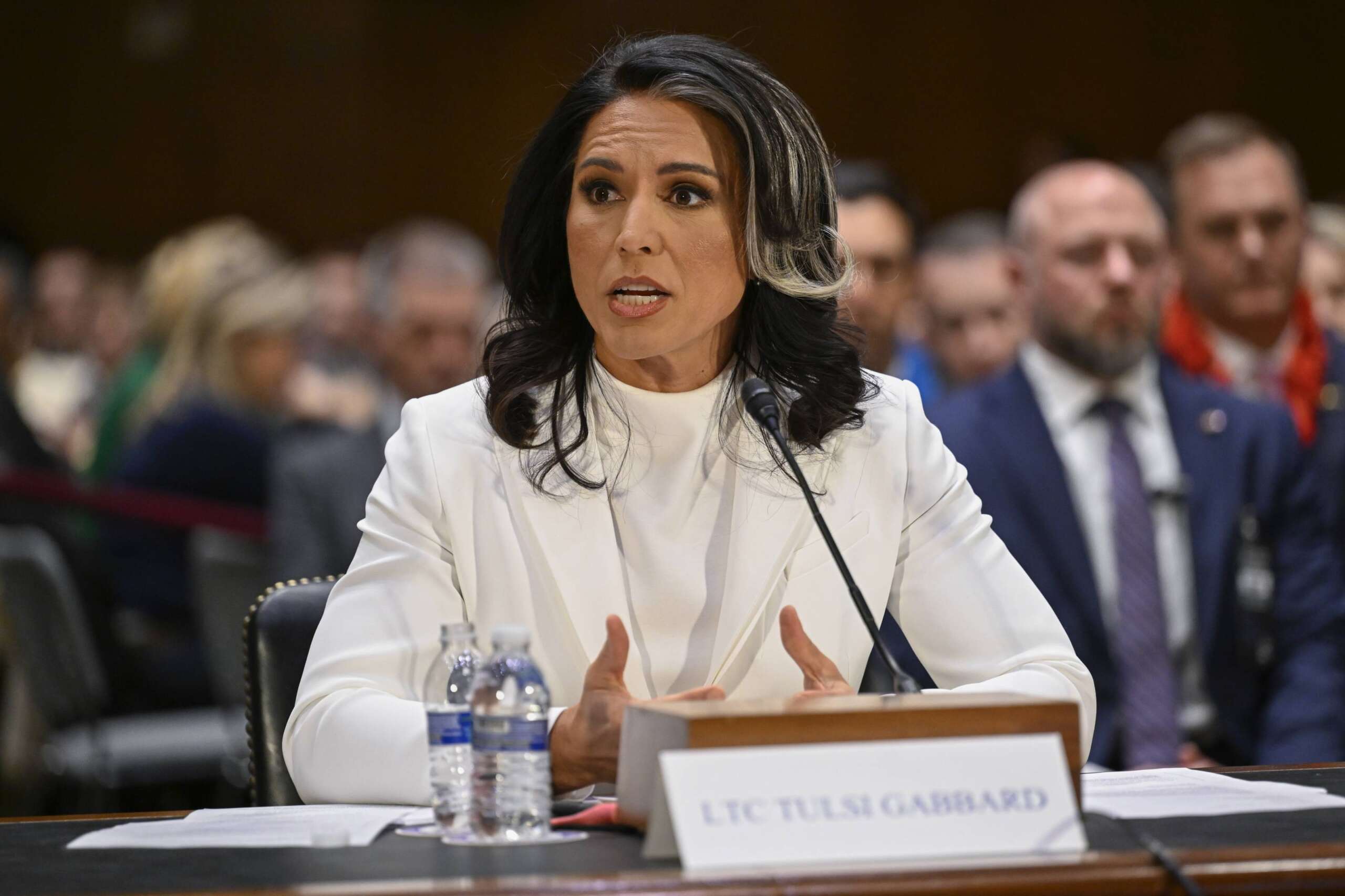
Gabbard resigns as director of national intelligence
May 22, 2026
Colorado closes legal gap for defendants found unfit to stand trial
🔍
May 22, 2026
FTC fines Cox Media Group $930K for fake AI listening ad service
🏫
May 22, 2026
Tennessee governor signs Memphis schools state takeover into law
View All Government Topics
769 topics
12 questions
Start the review