National Security · Foreign Policy · Constitutional Law·May 23, 2026
Trump declares Iran peace MOU largely negotiated
Final approval pending on 14-clause MOU to end Iran war
On May 23, 2026, President Trump posted on Truth Social that a peace agreement with Iran had been "largely negotiated," setting off a flurry of diplomatic signals 84 days into a war that closed the world's most critical oil chokepoint. The announcement centered on a 14-clause memorandum of understanding drafted by Vice President JD Vance, special envoy Steve Witkoff, and senior advisor Jared Kushner, covering a ~60-day ceasefire extension, an Iranian nuclear enrichment moratorium, U.S. sanctions relief, and procedures to reopen the Strait of Hormuz.
Iran's foreign ministry confirmed a framework existed but immediately complicated Trump's framing. Spokesperson Esmail Baghaei said nuclear issues would be handled in separate follow-on talks, not in the MOU itself, and that the Strait of Hormuz would remain under Iranian management — contradicting Trump's claim that the waterway "will be opened." Both governments sent the draft to their respective leaders for final approval, with no formal signing scheduled.
The deal's structure matters constitutionally. Trump is pursuing a Memorandum of Understanding — an executive agreement — rather than a formal treaty. That means the Senate plays no ratification role. Sanctions relief would come via executive order under IEEPA and OFAC authority, not an act of Congress. Four Republican senators had already voted with Democrats on May 19 to strip Trump's war powers in a 50-to-47 procedural vote, a pressure campaign that intensified as the MOU framework became public.
Key facts
President Trump posted on Truth Social on May 23, 2026, that 'An Agreement has been largely negotiated, subject to finalization between the United States of America, the Islamic Republic of Iran, and the various other Countries.' He said final deal details would be announced shortly and that the Strait of Hormuz 'will be opened.' The post came on day 84 of the 2026 Iran war, the conflict that began February 28 when the United States and Israel launched Operation Epic Fury against Iran.
The war started after U.S. and Israeli airstrikes killed Supreme Leader Ali Khamenei and struck Iran's nuclear infrastructure. Iran responded by closing the Strait of Hormuz on March 4, 2026, blocking roughly 20% of global seaborne oil and 20% of global LNG. Brent crude hit nearly $150 per barrel at peak disruption, and the IEA called it the largest oil supply disruption in history.
The 14-clause memorandum of understanding was assembled by Vice President JD Vance, White House special envoy Steve Witkoff, and senior advisor Jared Kushner. The three-man team had traveled to Islamabad in April for marathon talks with Iranian officials, with Vance reporting failure after 21 hours of negotiations before a separate round of talks resumed in subsequent weeks.
The MOU's core terms: Iran commits to a nuclear enrichment moratorium for an agreed period, agrees never to seek nuclear weapons, submits to enhanced UN snap inspections, and removes its stockpile of highly enriched uranium. The United States commits to lifting some sanctions and releasing a portion of Iran's frozen assets held abroad, estimated at over $100 billion across China, India, Qatar, Japan, and Iraq.
Iran's foreign ministry directly disputed Trump's framing on two key points. Spokesperson Esmail Baghaei said that 'at this stage, we do not have nuclear negotiations,' meaning the MOU does not contain nuclear terms, contrary to what U.S. officials described. On the Strait of Hormuz, Baghaei said any governance mechanism must be agreed between Iran, Oman, and the bordering countries, and that the United States 'has nothing to do' with it.
This divergence in public characterization is itself politically significant. Trump's Truth Social post served a domestic audience facing high gas prices and a war without congressional authorization. Iran's foreign ministry served a domestic audience that has lost over 3,375 people killed and 25,000 injured since the war began, according to official casualty figures.
The MOU is structured as an executive agreement, not a treaty. Under Article II, Section 2 of the Constitution, formal treaties require the advice and consent of two-thirds of the Senate. Executive agreements require no Senate vote. The JCPOA, the 2015 Iran nuclear deal Trump withdrew from in his first term, was similarly classified as a political commitment rather than a treaty, a structure that allowed Trump to exit it by executive action alone.
That same legal architecture applies here. Sanctions relief would flow through the president's authority under the International Emergency Economic Powers Act and OFAC executive orders, tools controlled entirely by the executive branch without a congressional vote. Congress imposed many Iran sanctions by statute, so some relief would require legislation the Republican-led House has not agreed to provide.
The War Powers Resolution of 1973 requires the president to notify Congress within 48 hours of committing forces to hostilities and to withdraw them within 60 days unless Congress authorizes the war. Trump notified Congress on March 2, making May 1 the 60-day deadline under most interpretations. The Trump administration argued the ceasefire, reached April 8, reset the clock. Democrats and some Republicans rejected that reading.
Senate Democrats forced eight successive votes on war powers resolutions, all failing until May 19, when a 50-to-47 procedural vote advanced a measure to restrict Trump's authority. The four Republicans who joined Democrats: Sens. Susan Collins of Maine, Lisa Murkowski of Alaska, Rand Paul of Kentucky, and Bill Cassidy of Louisiana. Senate Majority Leader John Thune said he didn't see an authorization vote happening 'any time soon.'
The Arms Control Association published an April 2026 analysis finding U.S. negotiators were 'ill-prepared for serious nuclear talks with Iran,' citing Witkoff and Kushner's lack of technical expertise on enrichment centrifuges, breakout timelines, and IAEA verification protocols. The Carnegie Endowment for International Peace noted that Iran's nuclear program remained intact after Operation Epic Fury's strikes, meaning the MOU's enrichment moratorium would need to be verifiable within months of signing.
The Council on Foreign Relations identified three core risks: Iran can restart enrichment the moment the MOU lapses or the U.S. withdraws; the deal's enforceability depends entirely on presidential will, with no congressional backstop; and U.S. withdrawal from the JCPOA in Trump's first term already established that Iran can't rely on executive agreements surviving a change in administration.
Economically, the global stakes are substantial. The Federal Reserve Bank of Dallas modeled that a full Hormuz closure removes close to 20% of global oil supplies, lowering global real GDP growth by an annualized 2.9 percentage points in Q2 2026. The World Bank projected developing economies would grow 3.6% in 2026, down 0.4 points from pre-war forecasts. Inflation in developing economies was forecast to average 5.1%, a full percentage point above pre-war projections.
Reopening the Strait wouldn't instantly normalize markets. Iran closed the strait on March 4 using mines, IRGC Navy swarm boats, and ship seizures. Mine-clearing alone takes weeks to months. The MOU's 60-day negotiating window means markets won't see full Hormuz restoration until late July or August 2026 at the earliest.
Sen. Mark Kelly, an Arizona Democrat and former Navy combat pilot, criticized the Witkoff-Kushner role in negotiations, telling The Hill that sending envoys 'without deep expertise in Iran's nuclear program' was dangerous. Kelly and fellow Democrats argued the Senate Foreign Relations Committee should be conducting oversight hearings on the MOU's terms before any deal is signed.
On the right, Sen. Lindsey Graham said he supported the framework if it included 'a real, verifiable commitment' to halt enrichment permanently. Graham has been one of the administration's strongest defenders of the Iran war and his conditional endorsement signaled Republican pressure on the enrichment terms even within the GOP coalition.
The MOU's 60-day follow-on negotiating window creates a second constitutional chokepoint. If those talks produce a binding agreement on Iran's nuclear program, including verification protocols, enrichment limits, and sanctions schedules, the question of whether that agreement requires Senate ratification as a treaty will almost certainly return to court. A non-binding political commitment, like the original JCPOA, can be exited by the next president unilaterally. A formal treaty can't be exited unilaterally, but it requires 67 Senate votes to ratify, a threshold neither party has come close to in recent decades.
The Iran Nuclear Agreement Review Act of 2015 gave Congress a 60-day review window for any nuclear agreement with Iran. Whether the Trump administration would comply with that statute for a follow-on deal, or argue it applies only to the JCPOA, is unresolved.
Related Topics
6⚖️
House GOP cancels Iran war powers vote, shielding Trump from rebuke
On May 21, 2026, House Republican leaders pulled a scheduled floor vote on H.Con.Res.40, a concurrent resolution that would have directed President Trump to withdraw U.S. forces from hostilities with Iran absent congressional authorization. The cancellation came after it became clear the resolution would pass. Rep. Gregory Meeks, the House Foreign Affairs Committee's ranking Democrat and the resolution's sponsor, said every Democrat had committed and enough Republicans were on board to win. Speaker Mike Johnson's decision to pull the vote put a procedural ceiling on the war powers debate that the Senate had cracked just two days earlier. On May 19, the Senate voted 50-47 to advance an equivalent measure, the first time it had done so in eight attempts since Operation Epic Fury began on February 28, 2026. Four Republican senators defected: Susan Collins of Maine, Lisa Murkowski of Alaska, Rand Paul of Kentucky, and Bill Cassidy of Louisiana. The House cancellation illustrated a core asymmetry in how the two chambers handle politically sensitive war votes. In the Senate, the discharge mechanism forced the measure onto the floor. In the House, leadership's scheduling power let Johnson simply not call the vote, even after Meeks had formally offered the privileged resolution, starting a clock that will require a vote when Congress returns from Memorial Day recess on June 2. The underlying War Powers Resolution 60-day clock, which ran from Trump's March 2 notification to Congress through May 1, had already expired without Congress acting. Trump asserted the clock didn't apply because the April 8 ceasefire meant hostilities had "terminated," a claim Democratic senators like Virginia's Tim Kaine rejected as having no basis in the statute. Operation Epic Fury officially concluded May 5, but the ceasefire's legal status under the War Powers Resolution remains contested.
98% match
30 questions
☢️
US and Iran resume nuclear talks as two carrier strike groups mass in Persian Gulf
On Feb. 26, 2026, the United States and Iran held a third round of indirect nuclear negotiations in Geneva, mediated by Oman, as Trump gave Iran a 10-to-15-day deadline to reach a deal or face military action. Trump's special envoy Steve Witkoff and Jared Kushner led the U.S. delegation in talks with Iranian Deputy Foreign Minister Abbas Araghchi. Simultaneously, the U.S. repositioned more than 150 aircraft to European and Middle Eastern bases, deployed 12 F-22 stealth fighters to Israel's Ovda Airbase — the first-ever F-22 deployment to Israel — and sent the USS Gerald R. Ford carrier strike group to waters off the Israeli coast, creating a two-carrier deployment alongside the USS Harry S. Truman. VP Vance told Fox News that Iran should take U.S. military threats "seriously" and that Trump had the "right" to use military force. Iran's spokesperson accused Trump of "big lies" and called the military buildup a provocation. Pentagon officials told reporters they expected the full U.S. force to be in place by mid-March.
96% match
17 questions
🌍
Trump demands a role in picking Iran's next supreme leader
On March 5, 2026, President Trump told Axios he must be "involved in the appointment" of Iran's next supreme leader. He called Mojtaba Khamenei — the assassinated ayatollah's son and clerical frontrunner — "a lightweight" who is "unacceptable to me." The comments came one week after Trump and Israel launched Operation Epic Fury, which killed Supreme Leader Ali Khamenei in the opening strikes. Trump's statement contradicted Defense Secretary Pete Hegseth's repeated assurances that "this is not a so-called regime change war" — though Hegseth added, "but the regime sure did change." Trump compared his planned involvement in Iran's succession to his handling of Venezuela, where he ordered the capture of Nicolás Maduro and said Delcy Rodríguez took power as a result. Iran's Assembly of Experts — an 88-member clerical council responsible under Iranian law for selecting a new supreme leader — had been bombed by Israel in Qom, apparently to disrupt the succession process. Analysts at the Quincy Institute and Al Jazeera noted the leader Trump wants does not exist within Iran's governing structure.
96% match
21 questions
💥
US and Israel launch Operation Epic Fury seeking regime change in Iran
On February 28, 2026, the United States and Israel launched coordinated military strikes on Iran, a joint operation the Pentagon named "Operation Epic Fury" and Israel called "Operation Roaring Lion." The strikes hit over 30 sites including areas near Tehran, Isfahan, Qom, Karaj, and Kermanshah, targeting Iran's missile infrastructure, military headquarters, and senior IRGC commanders. President Trump announced the attacks in an eight-minute video on Truth Social, calling them "major combat operations" and urging Iranians to "take over your government." Iran retaliated within hours, firing ballistic missiles and drones at Israel and U.S. military bases in Bahrain, Kuwait, Qatar, and Saudi Arabia. The strikes followed the collapse of the latest round of nuclear negotiations: just one day earlier, Oman's foreign minister had declared peace was "within reach" after Iran agreed to degrade its enriched uranium stockpiles. This is the second time the Trump administration launched military action against Iran in eight months, following the 12-day war in June 2025 that significantly weakened Iran's air defenses and nuclear infrastructure. At least 57 people were killed when an Israeli strike hit an elementary school in southern Iran, according to Iran's state-run IRNA news agency.
95% match
24 questions
🕊️
US and Iran hold indirect nuclear talks in Oman
The United States and Iran concluded indirect nuclear talks Friday in Muscat, Oman, with both sides agreeing to continue negotiations. Iran's Foreign Minister Abbas Araghchi led Tehran's delegation. The U.S. sent special envoy Steve Witkoff, Trump's son-in-law Jared Kushner, and CENTCOM chief Admiral Brad Cooper. The talks focused solely on Iran's nuclear program. Araghchi called the discussions "a good start" but said core differences remain unresolved. Trump warned of "very steep" consequences if Iran doesn't reach a deal. The talks occurred amid regional tension with increased U.S. military forces in the area. Oman served as mediator because the U.S. and Iran lack formal diplomatic relations. The inclusion of a military commander signals the credible threat of force backing negotiations.
94% match
18 questions
🛡️
US deploys F-22 fighters to Israel for first time amid escalating Iran tensions
By Feb. 22, 2026, the United States had assembled what military analysts and former commanders described as the largest American military buildup in the Middle East since the 2003 invasion of Iraq. The USS Abraham Lincoln carrier strike group had been in the region since late January. The USS Gerald R. Ford, carrying Carrier Strike Group 12, was seen transiting Gibraltar on Feb. 20 heading toward Israel''s coast. Long-range B-52 bombers and B-2 stealth aircraft were placed on higher readiness. F-16s, F-22s, and F-35s were moved forward to regional bases. Alert levels at Al Udeid Air Base in Qatar were raised. CNN reported on Feb. 18 that senior national security officials met in the White House Situation Room to discuss Iran, and that anonymous sources said the military was prepared to strike as early as Feb. 21 — though Trump had not made a final decision. Trump himself had set a public deadline of roughly 10 days at the Feb. 19 Board of Peace meeting. He said, "We may have to take it a step further, or we may not. Maybe we''re going to make a deal." As of Feb. 23, no strike had occurred. Experts warned that Iran has signaled it won''t respond with the relative restraint it showed after the June 2025 U.S. strikes on its nuclear facilities — when Iran gave the U.S. advance warning before targeting Al Udeid with missiles.
94% match
13 questions
Related
Categories that may be relevant to you
5 topics available

May 23, 2026
DOJ scrubs hundreds of Jan. 6 prosecution records from website
May 22, 2026
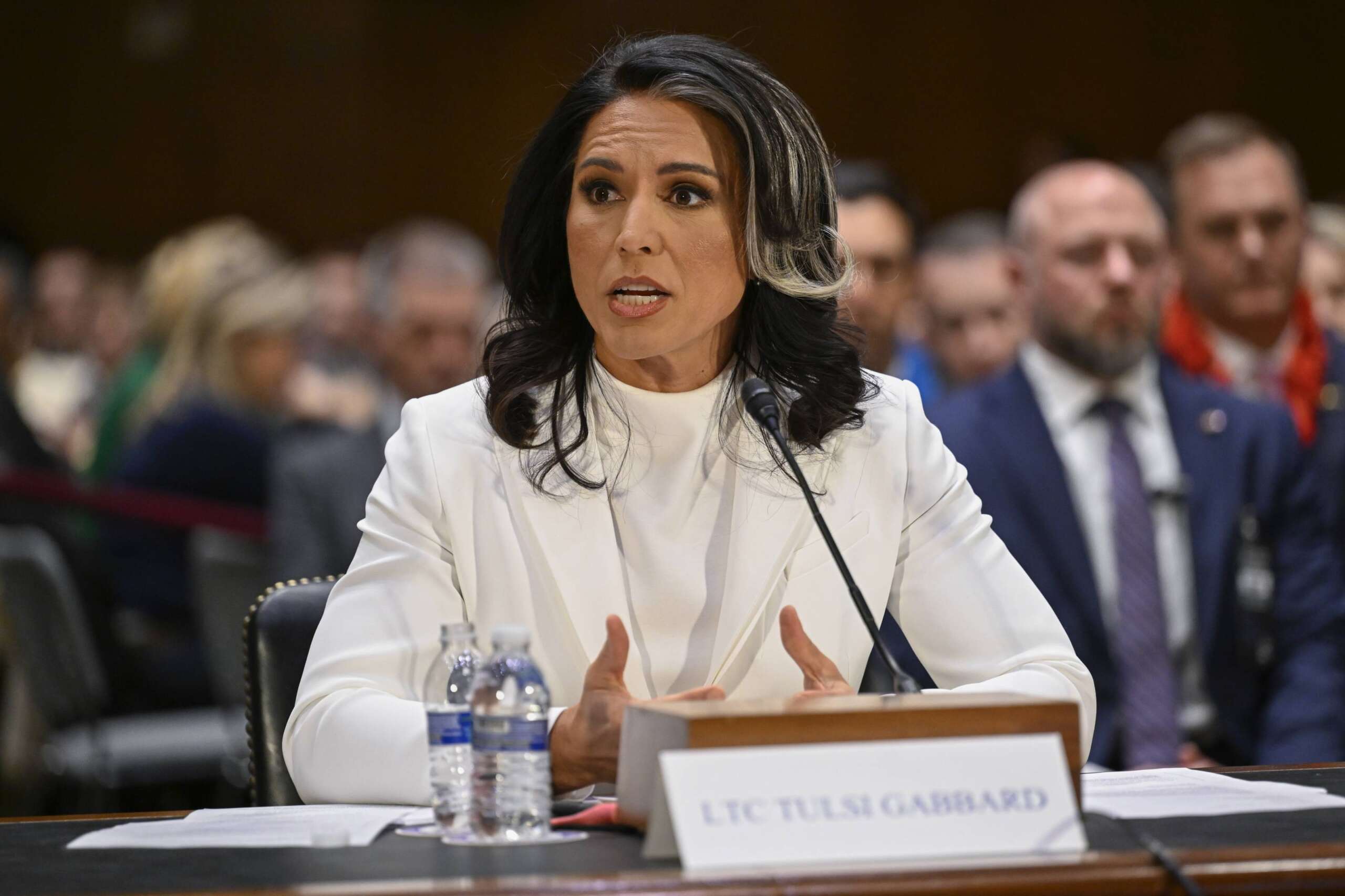
Gabbard resigns as director of national intelligence
⚖️
May 22, 2026
Colorado closes legal gap for defendants found unfit to stand trial
🔍
May 22, 2026
FTC fines Cox Media Group $930K for fake AI listening ad service
🏫
May 22, 2026
Tennessee governor signs Memphis schools state takeover into law
View All Government Topics
769 topics
30 questions
Start the review