June 20, 2025

Senate conservatives demand deeper cuts to Trump's spending bill

Congressional Bud...
Constitution Congress
The Hill
+7

Fiscal conservatives revolt against $3.8 trillion debt addition in signature legislation

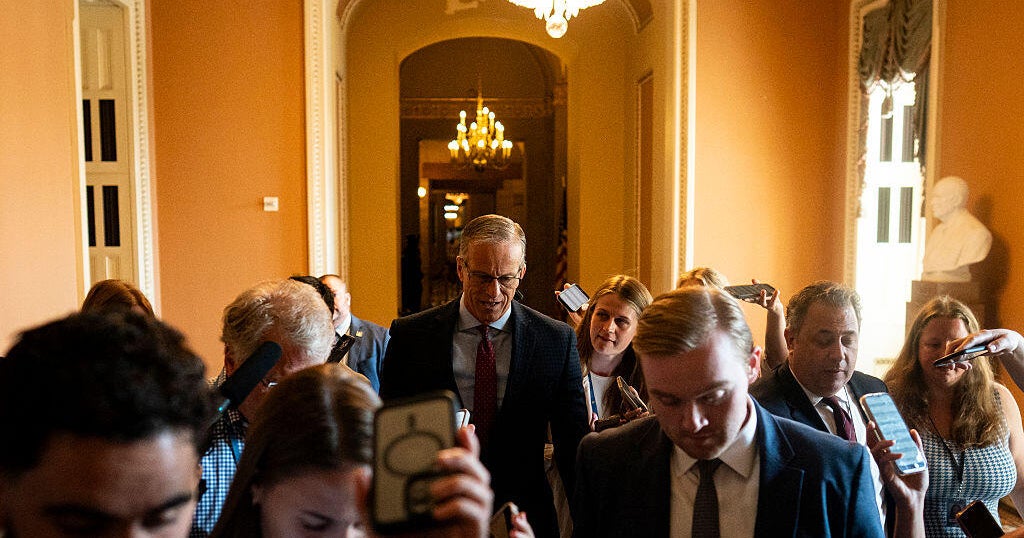
On Jun. 2025, Senate Majority Leader John ThuneJohn Thune confronted mounting pressure from fiscal conservatives — notably Senator Ron Johnson and other hard‑line GOP members — who demanded deeper spending cuts before they would support President Trump’s sweeping tax‑and‑spending package, exposing sharp intraparty debate over how much deficit financing is acceptable for large tax reductions. citeturn1search2turn1news14

Under current Senate practice, invoking cloture to end debate on most bills generally requires three‑fifths of the Senate, which in practice means 60 votes when the chamber is nearly full; that 60‑vote threshold gives individual senators substantial power to block legislation through extended debate or the filibuster. citeturn0search5

The budget reconciliation process — created by the Congressional Budget Act of 1974 and limited by the Senate’s Byrd Rule — allows legislation that primarily changes revenues or mandatory spending to be fast‑tracked in the Senate and passed with a simple majority, enabling major fiscal measures to bypass the normal 60‑vote filibuster hurdle. citeturn6search1turn6search4

The Congressional Budget Office’s cost estimate of the House‑passed “One Big Beautiful Bill” found that the package would increase federal deficits substantially over the next decade, with widely cited estimates in the Jun. 2025 CBO score putting the net ten‑year deficit impact in the trillions of dollars depending on whether dynamic economic effects are included. citeturn7search0turn4search1

Because deficit‑financed tax cuts raise federal borrowing, the CBO and other nonpartisan budget analysts warn that unpaid‑for tax reductions must ultimately be paid for either by future spending cuts, additional tax increases, or both; policymakers who accept larger near‑term tax cuts without offsets are likely to face fiscal tradeoffs later. citeturn8search5turn8search2

Rising federal debt increases the government’s interest‑payment burden, which in turn consumes resources that would otherwise fund programs or services and can force difficult choices about benefit levels, tax policy, or borrowing costs — a linkage the CBO has emphasized in its budget and long‑term outlooks. citeturn8search0turn8search5

Article I, Section 7 of the U.S. Constitution — the Origination Clause — requires that all bills for raising revenue originate in the House of Representatives, although the Senate may amend such bills after they pass the House; that constitutional rule shapes how Congress structures major tax legislation. citeturn0search0

A consequential procedural development occurred on Jun. 20, 2025, when the Senate parliamentarian, Elizabeth MacDonough, ruled that multiple provisions in the GOP package violated the Byrd Rule and therefore could not be included in a reconciliation bill unless the Senate secured 60 votes or otherwise revised the language; that decision forced Republicans to decide whether to rework the package, seek supermajority waivers, or proceed without the struck provisions. citeturn3news11turn3news12

📋Public Policy💰Economy🏢Legislative Process

Ready to test your knowledge?

Take the full quiz to master this topic and track your progress.

Start Quiz

People, bills, and sources

What you can do

1

Directly press Senate leadership: Call Senate Majority Leader John Thune’s Washington office at (202) 224-2321 and use his website contact form (https://www.thune.senate.gov/contact) to demand (a) that any reconciliation/amendment be accompanied by a full, public CBO score and (b) a floor statement explaining why/why not offsets will be required. Ask specifically for press secretary Annie Topp or Legislative Director Adam Wek and request a meeting with policy staff (schedule via the D.C. office number). citeturn8search5turn8search1

2

Target the conservatives who can block or reshape the package: organize constituents to phone/email these senators’ district and DC offices the same day (script below). Key contacts: Senator Ron Johnson (DC: 202‑224‑5323; Milwaukee: (414) 276‑7282). Senator Rand Paul (DC: 202‑224‑4343; press: Press_Paul@paul.senate.gov). Senator Mike Lee (DC: 202‑224‑5444). Senator Rick Scott (DC: 202‑224‑5274; Florida local offices listed on his site). For each office, ask to speak to the budget/legislative aide on tax and deficit issues and request a constituent meeting during their next district work period. citeturn9search0turn0search1turn9search8turn0search2

3

Use the CBO to anchor your ask: request CBO cost estimates and public briefings or submit a request for analysis (if you are an NGO or coalition) — CBO public contact: Media Relations (202) 226‑2602; email communications@cbo.gov; Budget Analysis Division for cost estimate requests (202) 226‑2800 / costestimates@cbo.gov. Ask CBO to publish (or republish) plain‑language Q&A about the bill’s 10‑year deficit impact and interest‑cost projections so you can use that in town halls and press outreach. citeturn1search0

4

Join and amplify organized campaigns (either to demand offsets/cuts or to oppose harmful provisions). Pick the organization that matches your goal, then RSVP and use their action toolkits: - Committee for a Responsible Federal Budget (CRFB) — policy briefings, public events, staff contacts: crfb@crfb.org / (202) 596‑3597. - Citizens for Tax Justice (CTJ) — research & mobilization: (202) 299‑1066 / info@ctj.org. - Fix the Debt — coalition & petitioning: info@fixthedebt.org / (202) 596‑3597. - Indivisible / local chapters — rapid action, town‑hall trackers and trainings (contact: contact@indivisible.org or local chapter pages). - Public Citizen — petitions and litigation support: main line (202) 588‑1000; member@citizen.org. If you favor faster, deeper cuts, coordinate with Club for Growth or Americans for Prosperity (Club for Growth: (202) 955‑5500; AFP: info@afphq.org / (703) 224‑3200). Build a cross‑group coalition to broaden the media narrative. citeturn3search4turn1search4turn2search0turn13search2turn7search7turn5search5turn4search1

5

Sign and circulate targeted petitions (and deliver them in person). Examples already live: change.org petitions opposing specific OBBBA provisions (remittances tax, land sales, protection of energy tax credits). Sign these and amplify locally using QR codes or printed flyers — e.g., 'Resist Trump's 5% tax on remittances' (Change.org), 'STOP THE SALE of Millions of Acres of Protected Federal Land' (Change.org), and the solar ITC protection petition. After you collect 100–500 local signatures, schedule a delivery to the senator’s district office (phone ahead; ask for the scheduler or district director). citeturn12search0turn12search2turn12search3

6

Organize a concrete local campaign timeline and tactics (sample, repeatable): 1) Week 1 — Host a public listening session / explain‑the‑CBO briefing using CRFB or CTJ one‑pager (invite local press). 2) Week 2 — Run a 48‑hour phone bank to the senator’s DC and district offices (use Indivisible or MoveOn phone‑bank toolkits; MoveOn can support petition printing). 3) Week 3 — Deliver petition and request an in‑person meeting with the senator’s budget aide; bring 100+ signed constituent sheets and one CBO one‑pager. 4) Week 4 — Hold a visible, permitted press event or vigil outside the district office the morning after the meeting and publish a local op‑ed the same day with quotes from meeting notes. Use Mobilize/MoveOn to recruit volunteers and CallHub/Spoke tools for phonebanks. For resources on printing petitions and logistics, see MoveOn’s petition printing help. Monitor the Senate hearings calendar and time your delivery before any cloture/markup deadlines (Senate hearings and committee calendar at senate.gov/hearings). citeturn13search4turn11search0turn3search4

7

Engage the press and hold lawmakers publicly accountable: (a) Email or call the senator’s press office to demand answers and to request they release staff briefings — press contacts are listed on Senate press directories; e.g., Rick Scott press staff contacts and John Thune’s press office are publicly listed. (b) Write a 300–500 word local op‑ed for your paper summarizing the CBO score and the local impact of Medicaid/SNAP cuts; include a line saying you offered to meet the senator and list date/time of the delivery/meeting. (c) Use social media: tag the senator, the press aide, and the advocacy groups you joined to amplify. Example media/press contact resources: Senate press list and individual senator press pages. This combination (meeting + petition + press) raises the political cost of ignoring a constituent demand. citeturn9search4turn8search5turn1search0