Immigration · Civil Rights · Justice·May 14, 2026
Judge orders U.S. to return Colombian woman deported to Congo
Federal judge finds deportation to Congo likely illegal after DRC refused to accept sick woman

U.S. District Judge Richard Leon ordered the  Trump administration to return Adriana Maria Quiroz Zapata, a 55-year-old Colombian woman, from the Democratic Republic of Congo after ruling her deportation was likely illegal. An immigration judge had previously granted Quiroz Zapata protection under the 📖Convention Against Torture, finding she'd likely face torture if returned to Colombia. ICE deported her to the DRC on April 16, two days after Congolese authorities formally refused to accept her, citing their inability to treat her diabetes, hyperlipidemia, and hypothyroidism. The government had tried to send her to half a dozen countries, all of which declined. Leon ordered a status update by 5 PM Friday on steps to bring her back.
Key facts
U.S. District Judge Richard Leon on May 14, 2026, ordered the Trump administration to return Adriana Maria Quiroz Zapata, 55, to the United States from the Democratic Republic of Congo. Leon, a George W. Bush appointee who took senior status in 2016, found the deportation under the Immigration and Nationality Act.
Leon ordered the administration to provide a status update by 5 PM Friday on steps taken to facilitate her return. He wrote that Quiroz Zapata "is likely to succeed" in her argument that sending her to the DRC violated federal immigration law.
Quiroz Zapata entered the U.S. from Mexico in August 2024 and was taken into ICE custody. She fled Colombia to escape a former partner tied to the Colombian national police who over years of abuse. She was trying to reach family in North Bergen, New Jersey.
In 2025, an immigration judge granted her protection under the 📖Convention Against Torture, finding it "more likely than not" she'd face torture if returned to Colombia with acquiescence of Colombian government officials.
The DRC formally notified ICE in writing on April 14 that it could not accept Quiroz Zapata because the country lacked the healthcare infrastructure to treat her diabetes, hyperlipidemia, and hypothyroidism. Two days later, on April 16, ICE put her on a anyway.
The government had previously requested to send her to half a dozen other countries. All refused. ICE also tried to before the Congo deportation, despite her having no ties to that country either.
Quiroz Zapata's health deteriorated in ICE detention before the deportation. Black spots grew on her back and foot, her skin peeled, and her nails blackened. Her attorney Lauren O'Neal told reporters the DRC for her conditions.
She was among at least 15 people deported to the DRC on April 17 as part of a secretive migration deal the Trump administration brokered with the Congolese government.
Federal immigration law under INA Section 241(b)(2) permits deportation to third countries only when it's "impracticable, inadvisable, or impossible" to return someone to their home country. The American Immigration Council notes that the law requires the to accept the deportee.
Judge Leon's ruling turned on this acceptance requirement. The DRC's written refusal on April 14, followed by ICE's April 16 removal flight, created a clear paper trail showing the government ignored the receiving country's formal rejection.
The case sits against the backdrop of the Supreme Court's June 2025 decision allowing the Trump administration to . The conservative majority overturned a lower court order requiring notice and a chance to challenge removal. Justice Sotomayor dissented, warning the court was "rewarding lawlessness."
In February 2026, U.S. District Judge Brian Murphy, a Biden appointee in Massachusetts, and the Constitution. Murphy ordered the government to provide meaningful notice before removals and give deportees a chance to challenge them. The administration appealed, setting up an ongoing clash between the executive branch and the judiciary.
Rep. Rob Menendez, a Democrat representing North Bergen, New Jersey, has worked with Quiroz Zapata and her family . He's advocated publicly for her return.
O'Neal, Quiroz Zapata's attorney, said she's preparing for how to respond if federal officials don't move quickly. She told CNN that "holding the executive branch to account is the only way to ensure proper oversight."
The 15 deportees sent to the DRC on April 17 included men and women from Colombia, Ecuador, and Peru. NPR reported that they're where water cuts out for days, rodents run through rooms, and mosquitoes are constant. They have no money or passports.
Two deportees told NPR they hadn't been vaccinated against yellow fever before being expelled. Several said they were deported despite ongoing U.S. court cases about their right to remain. Security at the hotel urged them to stay inside, effectively confining them in a country whose language they don't speak.
The Trump administration has transferred approximately 17,400 people to more than 30 countries under third-country deportation agreements, according to . Uganda, Rwanda, South Sudan, and Eswatini have also agreed to accept deportees alongside the DRC.
The Quiroz Zapata ruling doesn't strike down the broader policy but establishes that deportation to a country that formally refused to accept someone likely violates the INA. Other deportees with similar circumstances could cite this precedent.
The case number is Quiroz Zapata v.  Mullin (3:26-cv-01267), originally filed in the U.S. District Court for the . The defendants include the Secretary of the Department of Homeland Security.
Judge Leon's order from the D.C. district court adds to a growing body of federal rulings questioning the legal basis for third-country removals. Each case tests a different element: whether receiving countries consented, whether deportees received notice, and whether the government can circumvent torture protections by routing people through third nations.
Related
Categories that may be relevant to you
5 topics available

May 23, 2026
DOJ scrubs hundreds of Jan. 6 prosecution records from website
🔍
May 22, 2026
FTC fines Cox Media Group $930K for fake AI listening ad service
May 22, 2026
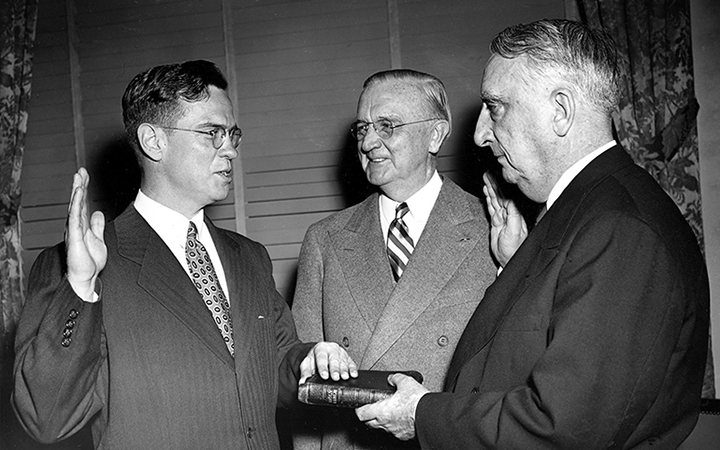
Warsh sworn in as Fed chair at White House in first such ceremony since 1987
May 22, 2026
Colorado closes legal gap for defendants found unfit to stand trial
May 22, 2026
Gabbard resigns as director of national intelligence
View All Government Topics
770 topics
27 questions
Start the review