Constitutional Law · Civil Rights · Elections · Electoral Systems·May 8, 2026
Virginia court voids redistricting referendum, keeps GOP maps
Virginia court strikes voter-approved map, blocking four Democratic House seats

Photo: AP Photo/Julia Demaree Nikhinsonsource ↗
The Supreme Court of Virginia struck down a voter-approved 📖redistricting amendment on May 8, 2026, in a 4-3 ruling that voided the results of Virginia's April 21 special election. More than 3.1 million Virginians had voted in that referendum, with 1,604,276 casting "yes" ballots to authorize the Democrat-controlled General Assembly to redraw congressional maps mid-decade. Justice D. Arthur Kelsey wrote for the majority that the legislature violated Article XII, Section 1 of Virginia's constitution by submitting the amendment after early voting had already begun in the 2025 House of Delegates elections, meaning more than 1.3 million Virginians who cast ballots in that election were denied a constitutional voice on whether to change the amendment process. The ruling keeps Virginia's current congressional map in place for 2026, preserving the existing 6-5 Democratic advantage and blocking a redrawn map that Democrats argued could have produced a 10-1 Democratic majority. Gov. Abigail Spanberger, Attorney General  Jay Jones, and House Speaker
 Don Scott filed an emergency motion to pause the ruling and appeal to the U.S. Supreme Court. The decision landed one week after the U.S. Supreme Court's ruling in Louisiana v. Callais gutted key 📖Voting Rights Act protections, accelerating Republican 📖redistricting efforts in southern states.
Key facts
The Supreme Court of Virginia struck down Virginia's 📖redistricting referendum on May 8, 2026, in a 4-3 decision written by Justice D. Arthur Kelsey. Voters had approved the constitutional amendment on April 21 by a margin of , roughly 51.69% to 48.31%, a gap of 3.38 percentage points. The ruling declared that vote null and void.
The court found that the General Assembly violated Article XII, Section 1 of the Virginia Constitution, which requires a constitutional amendment to pass the legislature twice with an intervening general election in between. The majority held that the 'general election' begins when early voting opens, not on Election Day itself.
Virginia's Democratic-controlled legislature first approved the 📖redistricting amendment on October 31, 2025, but early voting for the 2025 House of Delegates elections had opened on September 19. By October 31, had already cast ballots, about 40% of the total vote for that election cycle. The court found that those voters were denied their constitutional right to weigh in on the amendment before the legislature acted.
The second legislative vote came in January 2026, after Democrats expanded their House of Delegates majority in November 2025, gaining 13 seats. Voters then ratified the amendment in the April 21 special election. The court ruled the entire process was tainted from the start.
Justice Kelsey wrote that the commonwealth submitted the amendment 'in an unprecedented manner.' 'This violation irreparably undermines the integrity of the resulting referendum vote and renders it null and void,' he wrote. As a result, Virginia's congressional maps drawn by the state Supreme Court in 2021 remain in place, in Virginia's 11-seat U.S. House delegation.
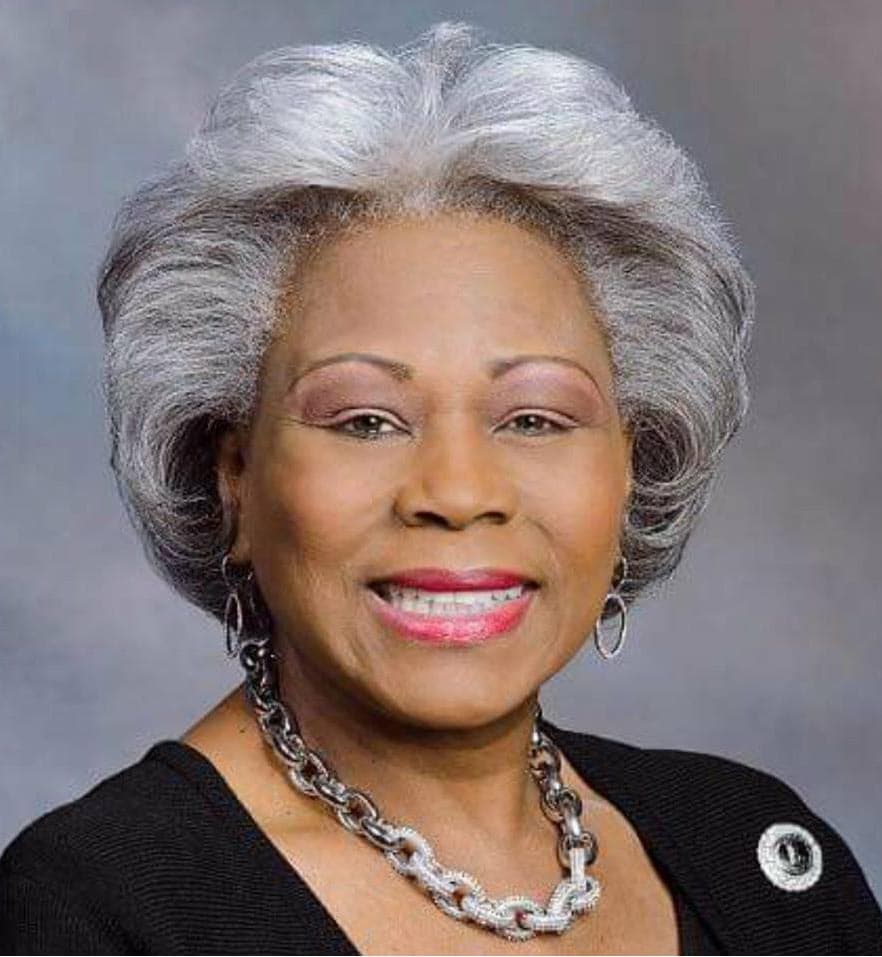
Chief Justice Cleo Powell, the first African American woman to lead the court, elected by the General Assembly in 2011 and re-elected in 2023, dissented, joined by Justices Mann and Fulton. Powell argued the majority's broad reading of 'election' to encompass the entire early-voting period contradicts both Virginia and federal law.
The redrawn map Democrats sought would have reshaped all 11 of Virginia's congressional districts to give Democrats a chance at , cutting Republican representation to a single district. Under the proposed map, 47% of Virginians who voted for Republican congressional candidates in 2024 would have been represented by just 9% of Virginia's U.S. House delegation. The court's majority cited this partisan imbalance in explaining the stakes of the procedural violation.
Democrats had framed the referendum as a direct response to President Trump's 2025 campaign urging Republican-led states, starting with Texas, to redraw their congressional maps mid-decade. Trump posted on Truth Social after the ruling: 'Huge win for the Republican Party, and America, in Virginia.'
Gov. Abigail Spanberger said she was 'disappointed' but pledged to focus on November. 'More than three million Virginians cast their ballots in Virginia's 📖redistricting referendum,' she said in a . Attorney General Jay Jones called it a politically motivated ruling. 'Today the Supreme Court of Virginia has chosen to put politics over the rule of law,' Jones said.
Republicans applauded the outcome. Senate Minority Leader Ryan McDougle, one of the plaintiffs who filed the original lawsuit in October 2025, said the ruling 'affirms what we all know: you cannot violate the Constitution to change the Constitution.' Former Gov. Glenn Youngkin posted that 'justice has been served.'
Virginia Democrats filed an emergency motion late Friday asking the state Supreme Court to pause its ruling while they prepare an appeal to the U.S. Supreme Court. The joint motion was filed by Attorney General Jones, House Speaker Don Scott, Senate Majority Leader
Scott Surovell, and Senate President Pro Tempore
 Louise Lucas. The confirmed plans for an 'Emergency Petition' to SCOTUS.
Legal analysts called it a long shot. The U.S. Supreme Court generally declines to second-guess state courts interpreting their own state constitutions. In 2023, it refused a request by North Carolina Republicans to override a state court ruling on congressional maps. 'The appeal to SCOTUS is a legal long shot,' 13News Now reported.
Virginia's justices are selected entirely by the General Assembly, not by gubernatorial appointment or partisan election. Both chambers of the legislature vote to elect justices to 12-year terms. That structure meant Virginia's Democratic-majority legislature elected the justices who then voted 4-3 against the Democratic 📖redistricting plan, reinforcing that the split tracked judicial philosophy on constitutional procedure, not a simple partisan divide.
Justice Kelsey, who wrote the majority opinion, was elected to the court by the legislature. Chief Justice Powell, who led the dissent, was also elected by the legislature, unanimously elevated to chief justice by her fellow justices in August 2025, effective January 1, 2026.
The Virginia ruling arrived one week after the U.S. Supreme Court's April 29 decision in Louisiana v. Callais, which eviscerated a key provision of the 📖Voting Rights Act. By a 6-3 vote, the high court invalidated Louisiana's second majority-Black congressional district, ruling that using race as a cannot be justified by Section 2 of the VRA absent proof of recent intentional discrimination. That ruling triggered rapid 📖redistricting moves in Alabama, Tennessee, and Louisiana, all aimed at eliminating majority-Black districts.
U.S. Rep. Jennifer McClellan (D-VA-04) tied the two decisions together, saying the Virginia ruling 'comes as GOP-led Southern states rush to dilute Black votes and erase Black representation in Congress following the gutting of the 📖Voting Rights Act.'
The 📖redistricting fight in Virginia was part of a sparked by Trump's 2025 push. Before 2025, only two states had voluntarily redistricted mid-decade since 1970. By May 2026, seven states had adopted new maps: California, Florida, Missouri, North Carolina, Ohio, Texas, and Utah, with more changes pending in Alabama, Georgia, Louisiana, and South Carolina. The Cook Political Report's Amy Walter estimated the total net benefit for Republicans in 2026 could reach four to five seats even before the Virginia ruling.
House Minority Leader Hakeem Jeffries told CNN: 'If the current map holds in Virginia, we will at minimum flip two seats.' He said Democrats were 'exploring other options' given Trump's declining approval ratings.
The case, Don Scott v. McDougle, was filed in October 2025 by Republican lawmakers including state Sen. Ryan McDougle of Hanover, state Sen. Bill Stanley of Franklin, Del.
Terry Kilgore, and 📖redistricting commission member Virginia Trost Thornton. They argued the legislature exceeded its authority and failed to follow required steps. A Tazewell County Circuit Court judge, Jack C. Hurley, ruled against the amendment in January 2026, and the state Supreme Court placed that ruling on hold to allow the April 21 vote to proceed. The Supreme Court heard and issued its ruling twelve days later.
Related Topics
6🗳️
Virginia voters approve redistricting amendment, Tazewell judge blocks it
On April 21, 2026, Virginia voters approved a constitutional amendment referendum that would let lawmakers directly redraw congressional maps, bypassing a 2020 bipartisan redistricting commission created to reduce partisan gerrymandering. The measure passed 50.7% to 49.3% out of 2.5 million ballots cast. However, on April 22, 2026—one day after the election—Tazewell County Circuit Court Judge Jack C. Hurley issued a final order declaring all votes "ineffective" and permanently enjoining the State Board of Elections from certifying results. Hurley ruled the House bill authorizing the referendum was "void ab initio" and violated Virginia's Constitution. He also called the ballot language "flagrantly misleading." This was Hurley's third ruling against the proposal. Virginia Attorney General Jay Jones announced an immediate appeal to the Court of Appeals of Virginia. If new maps had taken effect, they would shift the congressional layout from favoring Democrats 6-5 to 10-1, raising questions about which court has final authority over electoral outcomes and whether bipartisan redistricting commissions can be overridden by voter referendum.
96% match
21 questions
⚖️
Supreme Court sends Voting Rights Act cases in Mississippi and North Dakota back to lower courts
On May 18, 2026, the U.S. Supreme Court issued brief, unsigned orders vacating and remanding two redistricting cases — one from Mississippi and one from North Dakota — directing lower courts to reconsider under the standards set by the Court's April 29, 2026 decision in Louisiana v. Callais. The orders came via a GVR (grant-vacate-remand), a procedural mechanism SCOTUS uses to clear cases without writing a full opinion on the merits. The Mississippi case stemmed from a December 2022 lawsuit by the Mississippi State Conference of the NAACP. A three-judge federal panel ruled in July 2024 that the state's legislative maps violated Section 2 of the Voting Rights Act by diluting Black voting power. Mississippi was ordered to redraw districts and hold special elections; in November 2025, Democrats flipped two Senate seats, breaking the Republican supermajority for the first time in 13 years. The May 18 order vacates the ruling that required those elections. The North Dakota case involves the Turtle Mountain Band of Chippewa Indians and the Spirit Lake Tribe, who challenged the state's 2021 legislative map under the VRA. The Eighth Circuit had ruled in May 2025 that only the Justice Department — not private individuals or groups — can sue to enforce Section 2. The Fifth Circuit reached the opposite conclusion in 2023. Justice Ketanji Brown Jackson, the sole dissenter in both orders, argued the Court should have resolved that circuit split instead of remanding. The Callais ruling tightened VRA Section 2 standards significantly, requiring plaintiffs to prove intentional discrimination and revamping the 40-year-old Gingles framework. The GVR orders send both cases back to lower courts to apply those harder standards.
96% match
30 questions
⚖️
SCOTUS vacates order requiring Alabama's second Black district
On May 11, 2026, the U.S. Supreme Court issued an unsigned 6-3 order vacating the district court's injunction that had required Alabama to maintain two majority-Black congressional districts. The ruling came eight days before Alabama's May 19 primary and twelve days after the Court's April 29 Louisiana v. Callais decision gutted Section 2 of the Voting Rights Act. The order in Allen v. Caster (No. 25-243) lets Alabama use its 2023 congressional map, a map a federal court had already found to violate the VRA and to constitute intentional racial discrimination under the 14th Amendment. Alabama Attorney General Steve Marshall filed the emergency application on May 8 after Gov. Kay Ivey signed special session legislation authorizing new primaries in up to four districts if courts cleared the way. The practical consequence is immediate. Alabama's congressional delegation shifts from 5 Republicans and 2 Democrats to 6 Republicans and 1 Democrat. Rep. Shomari Figures, who won the redrawn majority-Black 2nd District in November 2024, was the first time in decades Alabama sent two Black members to Congress simultaneously. He now faces a district reconfigured to favor Republicans. Justice Sonia Sotomayor dissented, joined by Justices Elena Kagan and Ketanji Brown Jackson, arguing the Court discarded a "meticulously documented" finding of intentional discrimination without sound basis.
94% match
25 questions
🗺️
SC Senate cloture vote advances map to end Clyburn's Black district
On May 23, 2026, on Day 7 of a special session Gov. Henry McMaster called after the regular legislative session failed, the South Carolina Senate invoked cloture by a 26-18 vote to limit debate on a congressional redistricting bill. The bill would eliminate the state's only majority-Black 6th Congressional District, held by Rep. Jim Clyburn since 1993, and give Republicans a 7-0 advantage in the state's seven-seat U.S. House delegation. The special session opened May 15 after McMaster issued Executive Order 2026-09 forcing the legislature back into session. Five Republican senators had joined Democrats to block redistricting during the regular session, and six Republicans voted against a rules-suspension attempt on May 22 that required a two-thirds supermajority. Because that fast-track failed, Senate Republicans invoked a slower cloture-equivalent procedure under existing chamber rules, a majority-only threshold, setting the earliest governor's desk arrival at May 28-29. The push comes five weeks after the U.S. Supreme Court's April 29 ruling in Louisiana v. Callais, which struck down Louisiana's second majority-Black district as an unconstitutional racial gerrymander and significantly narrowed the Voting Rights Act's protection for majority-minority districts. South Carolina Republicans cite Callais as clearing the legal path to redraw the 6th District, which concentrates roughly 57% Black voting-age population. Civil rights groups and Democratic legislators argue the move is racial cracking, dispersing Black voters across Republican-majority districts where they can't elect a candidate of their choice.
93% match
30 questions
✊
Thousands rally in Alabama after Supreme Court guts VRA protections
A coalition of more than 90 civil rights, faith, labor, and community organizations staged the "All Roads Lead to the South" National Day of Action on May 16, 2026, beginning with a march across the Edmund Pettus Bridge in Selma and culminating in a mass rally at the Alabama State Capitol in Montgomery. The mobilization responded to the Supreme Court's 6-3 ruling in Louisiana v. Callais, which required plaintiffs to prove intentional racial discrimination under Section 2 of the Voting Rights Act. Within days of that April 29 decision, Alabama Attorney General Steve Marshall filed emergency motions to dissolve injunctions protecting two majority-Black congressional districts, and Governor Kay Ivey signed legislation scheduling special elections under redrawn maps. Organizers framed the rally as the launch of a sustained movement against what they called a coordinated effort to dismantle Black political representation across the South.
93% match
29 questions
🗳️
Virginia redistricting referendum cleared for April ballot, could flip 3-5 House seats
The Virginia Supreme Court ruled on Feb. 13, 2026, that the April 21 redistricting referendum can proceed despite Republican legislators' challenge. A Tazewell County circuit judge had blocked the measure on Jan. 27, but the state's highest court allowed the vote while continuing to review the case. The referendum asks voters whether to authorize mid-decade congressional redistricting that would likely favor Democrats. Virginia currently has a 6-5 Democratic congressional delegation under maps drawn by the state Supreme Court in 2021. Princeton Gerrymandering Project analysis shows Democrats could draw maps securing 9-10 of 11 seats. If voters approve the measure, Virginia would join 14 states using independent or special redistricting processes. Democrats and good-government groups support the measure as Republicans hold a 220-215 House majority, making Virginia critical to 2026 midterm control.
92% match
23 questions
Related
Categories that may be relevant to you
5 topics available

May 23, 2026
DOJ scrubs hundreds of Jan. 6 prosecution records from website
🔍
May 22, 2026
FTC fines Cox Media Group $930K for fake AI listening ad service
May 22, 2026
Warsh sworn in as Fed chair at White House in first such ceremony since 1987
May 22, 2026
Colorado closes legal gap for defendants found unfit to stand trial
May 22, 2026
Gabbard resigns as director of national intelligence
View All Government Topics
770 topics
34 questions
Start the review